


A Day Trip from Hurghada to Cairo: Pyramids, Sphinx & Egyptian Museum

Updated: 2 days ago

When you're staying in Hurghada and dreaming of seeing the ancient wonders of Egypt, a day trip to Cairo might seem ambitious—but trust me, it's absolutely worth it.
I embarked on this incredible journey to witness the Great Pyramids of Giza, stand before the enigmatic Sphinx, and explore the treasures of the Egyptian Museum.
The early morning start (we're talking 1.30 am pickup!) was challenging, but as the sun rose over the desert and the silhouettes of the pyramids appeared on the horizon, every minute of lost sleep became irrelevant.
Cairo, the Egypt's capital and one of the largest cities in Africa is home to about 22 million people. Cairo is loud, busy, and full of history.
Driving through Cairo’s streets is an experience on its own. Ancient history and modern life exist side by side here. Minarets, apartment blocks, traffic, and daily life everywhere.
This is my complete experience and everything you need to know to plan your own adventure.
The Great Pyramids of Giza
In the morning, we reached our first destination — the Giza Pyramids Complex.
Our first stop was a panoramic viewpoint overlooking the pyramids. This is one of the best places to see all three pyramids together.
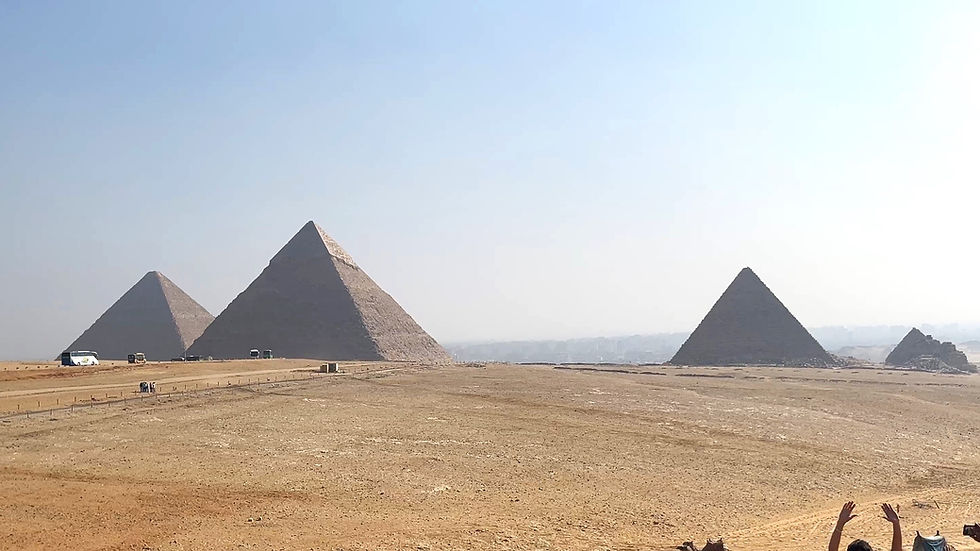
Nothing quite prepares you for the first moment you see the pyramids in person. These ancient monuments were built more than 4,500 years ago, during Egypt’s Old Kingdom. They were constructed as royal tombs for powerful pharaohs.
The Giza pyramid complex is home to the Great Pyramid ( Pyramid of Khufu), the pyramid of Khafre, and the pyramid of Menkaure, along with their associated pyramid complexes and the Great Sphinx.
Khufu, Khafre and Menkaure are a family of three generations with Khufu being the father, Khafre - the son and Menkaure - the grandson.
Walking/ driving around the complex, you'll have opportunities to explore each of the three pyramids.
The Three Main Pyramids
The Great Pyramid of Khufu
The largest pyramid, originally 146 meters tall, was the tallest man-made structure for over 3,800 years. It was built for Pharaoh Khufu, also known as Cheops over a period of about 26 years around 2580–2560 BCE.
It consists of approximately 2.3 million limestone blocks, each weighing several tons. The precision in its construction continues to amaze engineers and archaeologists.
The Great Pyramid of Khufu is the largest pyramid ever built and the only surviving wonder of the Ancient Seven Wonders.

The Pyramid of Khafre
Slightly smaller than Khufu’s pyramid, Khafre’s pyramid is notable for its well-preserved casing stones near the top. It sits on a higher plateau, giving the illusion of being taller. Nearby, the Great Sphinx guards the complex with its lion’s body and human head.

The Pyramid of Menkaure
The smallest of the three, Menkaure’s pyramid is still an impressive structure. It is accompanied by three smaller queens’ pyramids and showcases the evolution of pyramid construction techniques.

If you're feeling adventurous (and don't suffer from claustrophobia), you can enter each of the three pyramids for an additional fee.
Most often, people go inside the Great Pyramid (Khufu). You need an additional ticket on top of the general Giza Plateau entry, costing around 1,500 Egyptian Pounds (about $30 USD).
Inside the Great Pyramid, you'll find steep, narrow passageways and tunnels leading to the Grand Gallery and King's Chamber, which houses an empty sarcophagus.
For some people it can be hot and claustrophobic inside, also sometimes it is very crowded.
How the pyramids were built?
How the pyramids were built is still a subject of debate. There is no single, complete answer.
Most Egyptologists believe the pyramids were built by tens of thousands of skilled workers, not slaves, as once commonly believed.
The stones were likely transported using sledges, pulled over sand moistened with water to reduce friction.
It is believed that ramps were used to lift the stones, but the exact shape and system of these ramps is still unknown. What is certain is the precision of the construction.
The Great Pyramid is aligned almost perfectly with the cardinal directions. Even today, recreating such accuracy with modern technology would be extremely challenging.

The Great Sphinx
Our final stop at Giza was the Great Sphinx, a colossal limestone statue with a lion's body and human head.
Built around 2500 BC during Egypt's Old Kingdom, it's believed to represent Pharaoh Khafre. It serves as a guardian for the Giza pyramids and is a symbol of royal power.
The missing nose of the Great Sphinx has been the subject of many legends. A popular myth claims it was destroyed by Napoleon’s soldiers.
However, drawings from the 1700s already show the Sphinx without a nose — long before Napoleon arrived in Egypt.
Most historians believe the nose was deliberately damaged in the 14th century by a religious figure who attempted to destroy the nose as an act against what he saw as idol worship.
We also have to consider the century of erosion and harsh sun that also contributed to the destruction of the Sphinx's nose.
Dimensions: Approximately 240 feet (73m) long and 66 feet (20m) high, making it one of the world's largest monolithic statues.
Construction: Carved from a single piece of limestone bedrock, likely using stone hammers and copper chisels.
Photographing the Sphinx: The Sphinx is best viewed from the front, where you can appreciate its size and the detail of its face.
The way the Sphinx is positioned in front of the Pyramid of Khafre creates iconic photo compositions you've seen a thousand times—but experiencing it in person is something else entirely.
After Giza, we headed to lunch at a restaurant located on the banks of the Nile River.
A short break before continuing our journey through history in the Egyptian museum.
The Egyptian Museum
Our final stop was the Egyptian Museum in Cairo, home to an extraordinary collection of ancient Egyptian antiquities.
The Museum is located in Tahrir Square (often called the Old Egyptian Museum) and is one of the world’s most famous archaeological museums.
The Museum houses the largest collection of Egyptian antiquities in the world. The collection includes over 120,000 items.
Unfortunately, we missed the opening of the new Grand Egyptian Museum by less than two weeks. GEM opened on 1, November 2025.
Still, this museum holds an incredible collection of ancient Egyptian artifacts.
Highlights historically included:
The Tutankhamun collection, including the golden funerary mask, inner coffins, jewelry, and other treasures
Statues and relics from major periods of Egyptian history
Icons such as the Seated Scribe, Narmer Palette, and many Old, Middle, and New Kingdom masterpieces

During mid-October 2025, when I was there a major transition of Tutankhamun artifacts was underway. The Tutankhamun Gallery has been removed permanently from the old museum as the treasures are now being moved to their new home at the GEM.
On display was the golden mask of Tutankhamun. Discovered in 1922, the mask is made of solid gold and is one of the most famous artifacts in the world.
We also saw Tutankhamun’s sarcophagi, which once protected the young pharaoh’s mummy.
Now, in the Grand Egyptian Museum you can see the entire Tutankhamun collection — over 4,500–5,000 artifacts for the first time in history. This includes the golden mask, coffins, chariots, jewelry, throne, and many everyday objects from his tomb.
Filming and photography in the Tutankhamun Gallery were strictly prohibited. That's why I can't show any photos from there.
Despite the opening of the new Grand Egyptian Museum, this older museum will remain open and continue to exhibit its impressive collection of artefacts.
Practical Information
Duration & Travel Time
The trip takes 20-22 hours by bus. Hurghada to Cairo is approximately 5-6 hours by road each way. Most tours depart around 2-4 AM and return by 10-11 PM.
Alternatively, you can make this tour by plane as well. The journey would take 8-10 hours.
Approximate Costs
Day tours range from $80-150 per person including transport, guide, lunch, and entrance fees. Private tours cost more but offer flexibility.
Best Time to Visit
October to April offers the most comfortable weather. Summer months (June-August) can be extremely hot, with temperatures exceeding 40°C.
What to Bring
Comfortable walking shoes, sunscreen, hat, sunglasses, camera, water bottle, and cash for tips and souvenirs ( US dollars or Egyptian pounds ). Dress modestly for the museum.

Tips for Your Visit
• Book through a reputable tour operator—read reviews carefully
• Ride a camel only with a trusted guide. A popular scam tourists face is to be blackmailed to pay a high amount of money in order to be taken down from the camel in the end.
• Bring Egyptian pounds for small purchases and tips (guides, drivers, etc.)
• Expect persistent vendors at the pyramids—a polite but firm "no thank you" works best
• Charge all your devices the night before or bring portable power bank—it's a long day of photos!
• Consider a private tour if traveling with family or wanting more flexibility
• Bring snacks for the journey—the drive is long and meal stops can be brief
In Conclusion
Was the day trip from Hurghada to Cairo worth the early wake-up call and long journey? Absolutely, without a doubt. Standing before monuments that have witnessed thousands of years of human history is a humbling and awe-inspiring experience that I'll never forget.
Yes, it's a long day. Yes, you'll be tired. But you'll return to your hotel with memories, photos, and stories that will last a lifetime. The pyramids, the Sphinx, and the treasures of the Egyptian Museum are bucket-list destinations.
If you have the opportunity to make this trip, don't hesitate. Ancient Egypt is calling!
Enjoy the Video
If you're planning a holiday in Hurghada, Serry Beach Resort may be a good choice for you. Read my honest review here:


Comments